
How to Book More Meetings on LinkedIn in 2026 Using LinkAngler
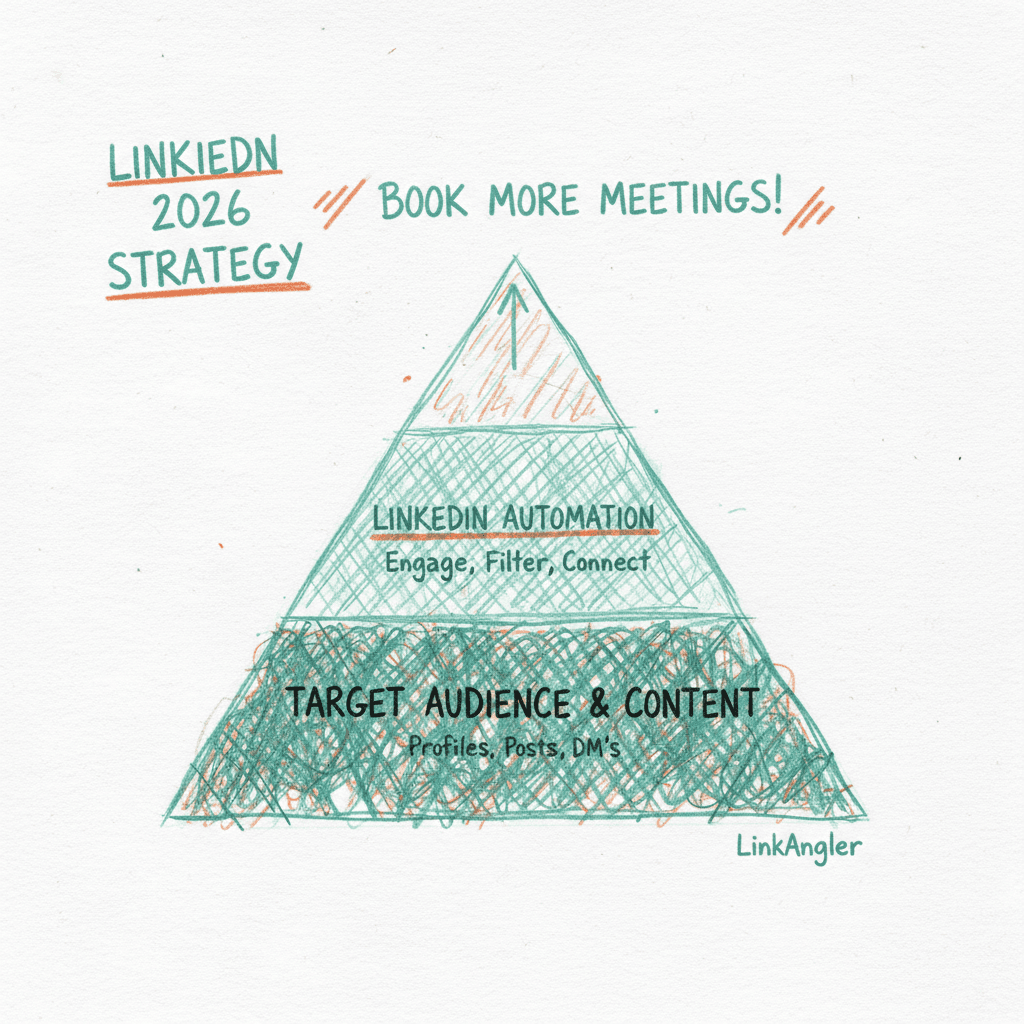
Booking meetings on LinkedIn has never been more competitive. Inboxes are noisy, attention spans are short, and prospects have become remarkably good at ignoring generic outreach. Yet some salespeople, founders, and recruiters are quietly filling their calendars week after week — not by working harder, but by working smarter with the right LinkedIn automation tool and a well-designed outreach system.
This guide is about that system. Not the spray-and-pray stuff. Not the "connect with everyone and see what sticks" approach. We're talking about a deliberate, multi-step process that takes someone from "never heard of you" to "let's find a time to chat" — and doing it at scale without sacrificing the personal touch that actually gets replies.
Let's get into it.
Start With the Right People (Seriously, This Step Matters Most)
Here's the uncomfortable truth: most outreach problems aren't messaging problems — they're targeting problems. You can write the world's greatest cold message, but if you're sending it to people who have zero reason to care, you're wasting everyone's time.
Before you touch any automation, you need a clear picture of your Ideal Customer Profile (ICP). Think beyond job title:
- What company size is a realistic fit for your offer?
- What industry signals suggest someone has a problem you solve?
- Are there recent events (new funding, hiring surge, leadership change) that make timing right?
- What does their LinkedIn activity tell you about their priorities?
Once you have that picture, your LinkedIn automation tool can do the heavy lifting on discovery. LinkAngler's AI Lead Discovery pulls relevant prospects based on your ICP criteria and assigns each one a lead score from 0 to 100. That score factors in how closely they match your target profile — so instead of blasting 500 people and hoping for the best, you're starting with a curated list of people who are genuinely worth your time.
This changes everything downstream. Higher-quality inputs mean higher-quality conversations, which means more meetings booked per message sent.
Build a Campaign That Warms People Up (Don't Lead With the Ask)
One of the biggest reasons outreach fails is the cold meeting request — that dreaded "I'd love to jump on a quick call" message that arrives approximately 30 seconds after connecting.
People don't book meetings with strangers. They book meetings with people they find credible, relevant, and worth their time. Your campaign needs to build that perception before you ask for anything.
Here's a simple but effective multi-step structure:
Step 1: Connection Request (Personalised, Low Pressure)
Your connection request should feel like a genuine reach-out, not a pitch. Reference something specific — their role, a post they wrote, a company milestone. Keep it to 2-3 sentences max. The goal is just to get accepted.
Step 2: Warm Welcome Message (No Ask)
Once they accept, send a message that acknowledges the connection and adds a tiny bit of value. Share a relevant insight, ask a curious question, or mention something you genuinely found interesting about their work. Do not pitch. Do not ask for a call.
Step 3: Value-Add Follow-Up
A few days later, send something genuinely useful — a resource, a data point, a case study that's directly relevant to their situation. This is the message that starts to shift you from "random stranger" to "person worth paying attention to."
Step 4: The Soft Ask
Now you can ask for a conversation. But even here, frame it around them — not your product. Something like: "Would it make sense to chat for 15 minutes about [specific problem]? Happy to share what we've been seeing in [their industry]."
LinkAngler's multi-step campaign automation lets you build exactly this kind of sequence — connection requests, timed messages, delays between steps — all running in the background while you focus on the actual conversations.
Use Video and Voice to Stand Out in a Crowded Inbox
Text messages are table stakes in 2026. If you want to meaningfully increase your reply rate (and your meeting booking rate), you need to add a layer that most people aren't doing.
That layer is video and voice.
Think about it from the prospect's perspective: they get dozens of text-based LinkedIn messages every week. Then one day, they get a short personalised video message — maybe 60 seconds — where someone is clearly talking directly to them, mentioning their name, their company, a specific challenge they likely face. That's impossible to ignore.
Here's how to make this work without spending hours creating individual videos:
AI-personalised video messages let you record one core video and generate personalised variations for each prospect — different intros, different name mentions, different company references. LinkAngler's video message feature uses AI lip-syncing to make this feel natural and genuinely personalised, not like a template with a mail merge.
Voice notes add a different kind of warmth. A short voice message in someone's LinkedIn inbox is still unusual enough to stop the scroll. With ElevenLabs integration, you can send AI-generated voice notes at scale — even clone your own voice for a consistent, authentic sound.
And then there's the video landing page: instead of dropping a raw video link or a calendar link cold, you send prospects to a branded page where the video auto-plays, they see your face and message immediately, and there's a booking link right below. It converts better because it removes friction and adds context.
The data is pretty clear here — video and voice outreach consistently outperforms text-only sequences when done right. If your LinkedIn automation tool isn't supporting this kind of multi-format outreach, you're leaving reply rates on the table.
Engage With Prospects Before and During Your Campaign
Here's a tactic that most people overlook: LinkedIn post engagement as a warm-up layer.
Before you send a connection request to a high-value prospect, engage with their content a few times. Like a post, leave a thoughtful comment, share something they wrote. When your connection request arrives shortly after, it doesn't come out of nowhere — they've already seen your name and (ideally) found your comment worth reading.
This isn't just about appearing on their radar. It's about demonstrating that you're a real person with genuine opinions — not just another automation bot spamming their inbox.
LinkAngler's AI post engagement feature lets you do this at scale, with customisable AI personas that engage with prospects' content in a way that matches your voice and tone. You set the guardrails, the AI handles the activity.
The result? By the time your connection request lands, there's already a faint sense of familiarity. That tiny bit of recognition can meaningfully improve your acceptance rates.
Timing and Sequencing: The Details That Actually Move the Needle
Even with great targeting and great messaging, poor timing can kill your results. Here are a few sequencing principles worth following:
Don't message too fast after connecting. If someone accepts your connection and gets a message within 30 seconds, it screams automation. Build in a natural delay — a few hours at minimum, a day or two for better results.
Don't wait too long either. If you wait a week to follow up after connecting, the momentum is gone. The sweet spot is usually 24-48 hours for your first message.
Respect time zones. Sending messages at 2am in your prospect's timezone is just burning send credits. Most good LinkedIn automation tools (including LinkAngler) have quiet hours settings that ensure your messages arrive during business hours, wherever your prospect is located.
Limit your follow-up touches. There's a point where follow-ups stop feeling persistent and start feeling annoying. For most campaigns, 4-5 touchpoints across 2-3 weeks is a reasonable ceiling. After that, if there's no engagement, move on gracefully.
Monitor engagement signals. If someone is opening your messages but not replying, or engaging with your content but not responding to outreach, those are signals worth acting on. LinkAngler's hot lead detection flags prospects who are showing interest so you can prioritise manual follow-up where it matters most.
Measure What's Actually Working
Booking meetings is the outcome, but to improve your results over time, you need to track the inputs. Here's what to measure:
- Connection acceptance rate — if this is low (under 25%), your targeting or connection message needs work
- Reply rate — if people accept but don't reply, your opening message isn't compelling enough
- Meeting booking rate per conversation — if you're getting replies but not meetings, your ask or your offer needs refining
- Which message step generates the most replies — this tells you where the real value in your sequence sits
Use these metrics to run simple A/B tests. Try two different connection request messages for a month. See which performs better. Iterate.
The best salespeople treat outreach like a system to optimise, not a task to complete. A good analytics dashboard makes this much easier — you can spot drop-off points in your funnel and fix them without guessing.
Putting It All Together: A Realistic Expectation-Setting Moment
Let's be honest about what "booking more meetings" actually looks like in practice. A well-optimised LinkedIn outreach sequence — with good targeting, a warm multi-step flow, and video/voice elements — might convert at 5-15% into booked meetings from first connection.
That sounds low until you run the numbers: if you're connecting with 100 well-targeted prospects per week and booking 5-10 meetings from that activity, that's a very full calendar. Consistently.
The goal isn't to blast thousands of people with mediocre outreach. It's to send focused, high-quality sequences to people who genuinely match your ICP — and give them compelling, personalised reasons to say yes to a conversation.
That's where a LinkedIn automation tool earns its keep: not by doing volume for volume's sake, but by letting you execute a quality system consistently, without it consuming your entire day.
Quick-Start Checklist
Ready to put this into action? Here's a condensed checklist:
- Define your ICP clearly — industry, company size, role, pain points, timing signals
- Use AI lead discovery to build a scored, targeted prospect list
- Design a 4-5 step campaign — connection, warm message, value add, soft ask, follow-up
- Add a video or voice message to at least one step in your sequence
- Set up a video landing page with a booking link for your warm prospects
- Enable post engagement to warm up high-value prospects before your outreach
- Configure quiet hours and natural delays between message steps
- Track your key metrics and run monthly A/B tests on your messages
- Prioritise hot leads for manual personalisation and faster follow-up
Wrapping Up
Filling your calendar with qualified meetings in 2026 isn't about sending more messages — it's about sending better messages to better-fit people, in a way that feels human and valuable at every step. The right LinkedIn automation tool makes that possible without turning you into a full-time outreach machine.
Build the system, let automation handle the repetition, and focus your personal energy on the conversations that actually move deals forward. That's the play.
If you're curious how LinkAngler fits into this system, explore the full feature set or take a look at how it supports sales teams specifically. The setup is faster than you'd think.